Explore the global economic landscape of 2025, highlighting mixed growth influenced by geopolitical conflicts, inflation, and adverse conditions. The analysis covers regional consumption and export trends, overall GDP performance, labor market dynamics, inflationary pressures, and fiscal outcomes. It also examines central bank policies and liquidity adjustments, while assessing the potential for sectoral growth and the risks to fiscal stability amid ongoing global trade tensions.
Slide right to see more
Annual Economic Survey Highlights

Global Growth Remained Resilient
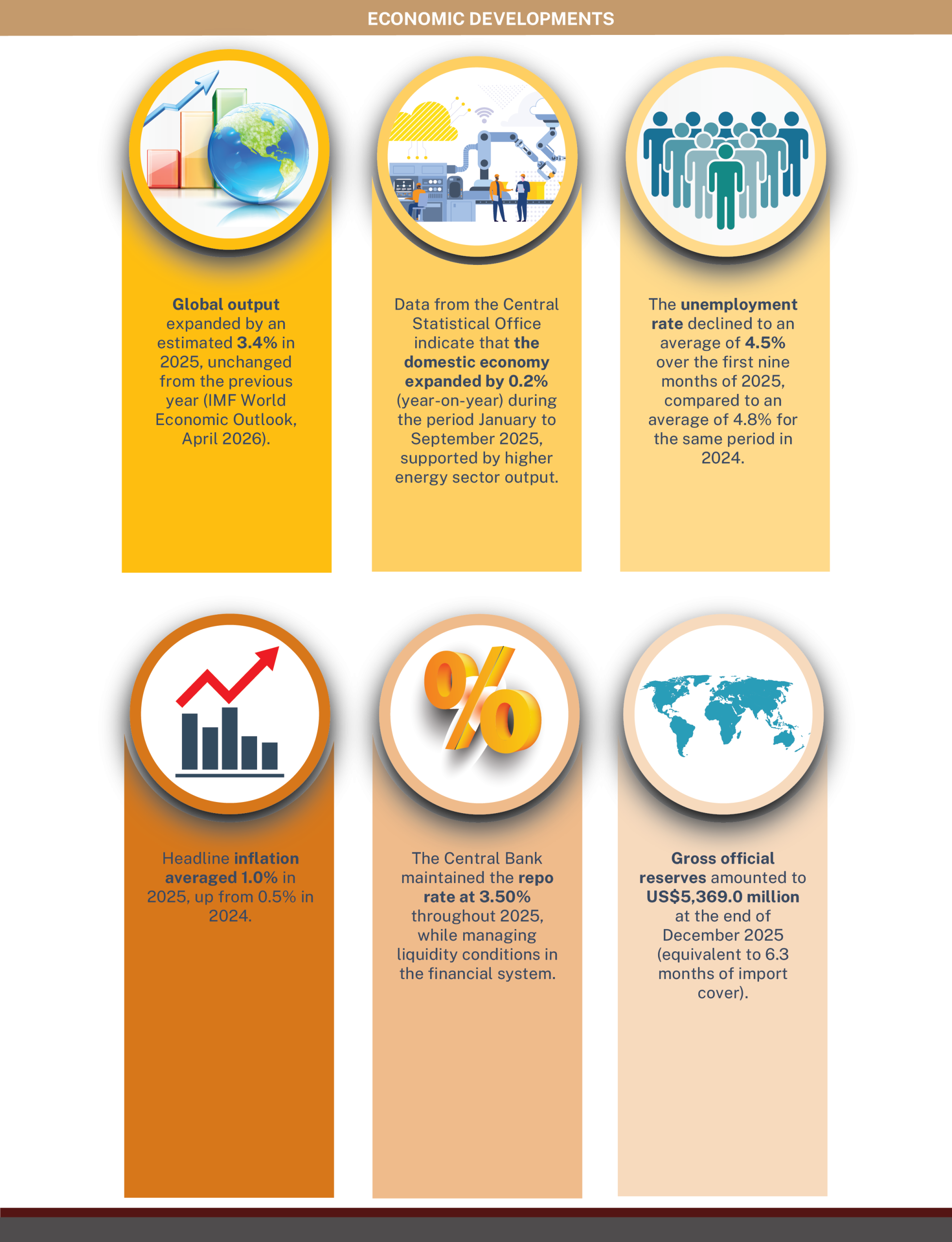
Global growth remained resilient in 2025, supported by continued expansion in Emerging Market and Developing Economies, despite lingering inflationary pressures, geopolitical tensions and tariff uncertainty.

Inflation Trends
Inflationary pressures edged upwards but remained contained in 2025, driven mainly by higher international food commodity prices.

Positive Growth Driven by Consumption and Exports
Economic activity across the Latin American and Caribbean (LAC) region was moderate but subdued, reflecting resilient private consumption and easing inflation pressures.

Fiscal Challenges
Higher energy receipts outstripped the decline in non-energy revenue, leading to a more favourable fiscal outturn for the fiscal year ending September 2025.

Domestic Economic Performance
Domestically, economic activity showed signs of moderation during 2025. Data from the Central Statistical Office (CSO) indicate that real GDP recorded modest growth over the first nine months of the year, with increased energy sector output partially offset by reduced non‑energy sector activity.

Monetary Policy Update
Monetary policy in 2025 was geared towards fostering conditions supportive of domestic economic activity and, more specifically, on managing volatile liquidity.

Labor Market Trends
Labour market conditions remained broadly stable over the first three quarters of 2025, with the unemployment rate averaging lower than in the previous year.

External Account Dynamics
The external current account recorded a surplus in 2025; however, net outflows on the financial account resulted in an overall balance of payments deficit and a decline in gross official reserves.

Economic Outlook
Global economic prospects remain subject to heightened uncertainty, particularly with the escalation of geopolitical tensions in the Middle East and their potential implications for trade, commodity prices and financial markets. Against this backdrop, economic activity in Trinidad and Tobago is expected to stabilise over the short to medium term. Energy sector output is expected to benefit from the start‑up of new natural gas fields; however, production levels are unlikely to increase beyond already achieved levels. Non‑energy sector activity remains uncertain, with recent policy initiatives and cost‑related pressures weighing on economic sentiment. Inflation is expected to remain relatively contained, notwithstanding upside risks stemming from US tariffs, higher international prices and administered price adjustments. On the external front, improved energy exports are likely to support the current account, although continued net outflows on the financial account may constrain reserve accumulation.
2024 Outlook: Modest Growth Amid Challenges
Global economic growth is anticipated to remain steady in 2024. Several forces shaping the outlook include subdued activity in advanced economies, mounting geopolitical conflicts, and tight financial conditions. Economic prospects for Trinidad and Tobago are modestly favorable over the short to medium term, as subdued energy sector activity is anticipated to partially offset strong growth in the non-energy sector. While inflation is anticipated to remain low in 2024, the actual pace of price movements will depend largely on changes in utility or tax rates, adverse weather conditions, and the stability of global commodity prices. Heightened geopolitical tensions could also reignite spikes in commodity prices and freight costs, disrupting the global disinflation path.